AI-Powered Anomaly Detection for Workiva
Revolutionizing how financial professionals identify data inconsistencies in collaborative spreadsheets through intelligent automation and intuitive design.
The Challenge
Workiva users were spending 73% more time than necessary reviewing collaborative reports for data anomalies and formatting inconsistencies. With datasets growing exponentially and compliance deadlines tightening, manual detection methods were failing at scale.
Research & Discovery
Understanding the Problem Space
Through extensive user research with Business Analysts and MIS professionals, I uncovered critical pain points in the current anomaly detection workflow. Users were relying heavily on domain knowledge and manual scanning, leading to inconsistent results and missed outliers.
User Interviews
6 participants across Business Analysts and MIS students using structured 18-question framework
Thematic Analysis
Identified 3 core themes: automatic flagging, learnability, and visualization needs
Competitive Analysis
Evaluated existing solutions and identified gaps in enterprise-grade anomaly detection
Key User Insights
"Ideally it would tell me what the problem could be as well. So let's say there's an increase in acquisitions this month. Maybe we can tell me that it's possibly because this variable seems to have too many missing values."
"An alert system basically like the moment it finds out an alert and it should be real time. It should actually tell you where exactly is the error instead of just telling that there is something wrong."
Flagging
Users need automated systems that can identify anomalies and provide contextual explanations for why data points are flagged as unusual.
Real-time Alerts
Immediate notification systems that pinpoint exact locations of errors rather than general warnings about data quality issues.
Visual Hierarchy
Clear color-coding and visual indicators that make anomalies immediately recognizable within large datasets.
User Personas

Sarah Mitchell
Goals
- Learn anomaly detection best practices quickly
- Gain confidence in identifying data issues
- Understand why certain data points are flagged
Pain Points
- Overwhelmed by complex datasets
- Unsure which anomalies are critical
- Needs contextual help and guidance
Tools Used

David Chen
Goals
- Process large datasets efficiently
- Customize detection parameters for specific use cases
- Integrate findings into automated workflows
Pain Points
- Manual detection is time-consuming
- Inconsistent results across team members
- Difficulty prioritizing high-impact anomalies
Tools Used
Wireframes
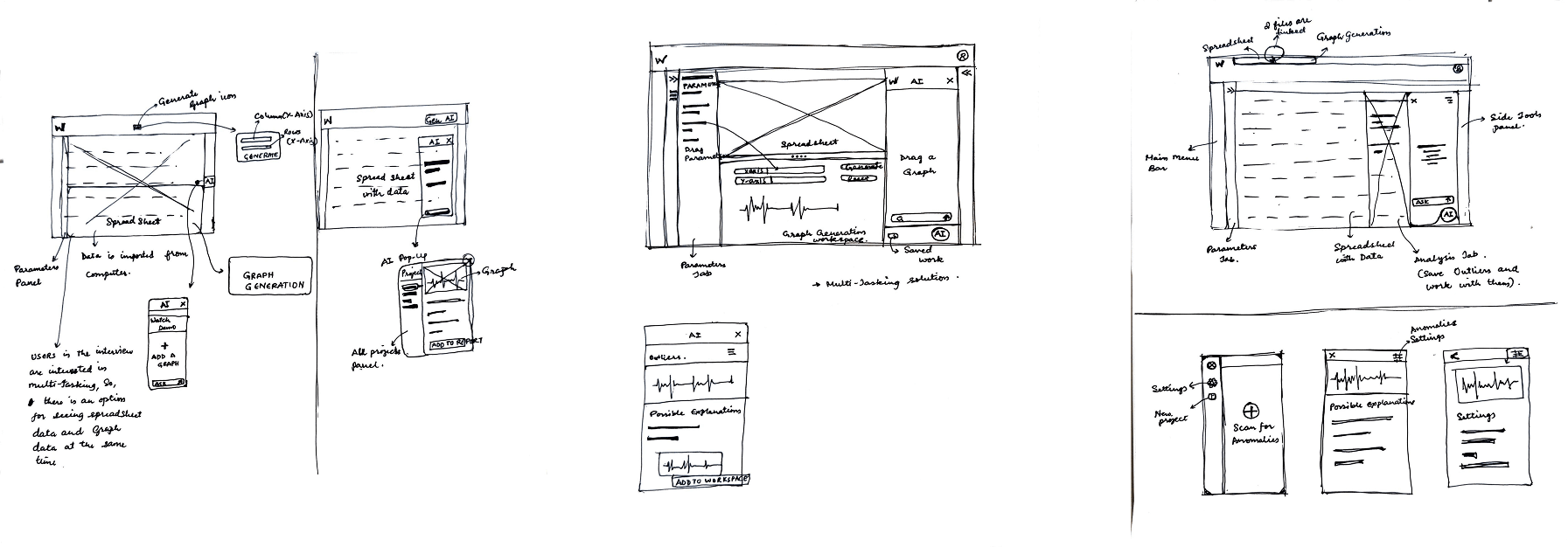
Low-fidelity wireframes exploring different approaches to anomaly visualization
Design Solution
AI-Powered Anomaly Detection Interface
The solution integrates machine learning algorithms with an intuitive interface that provides real-time anomaly detection, contextual explanations, and actionable insights directly within the Workiva spreadsheet environment.
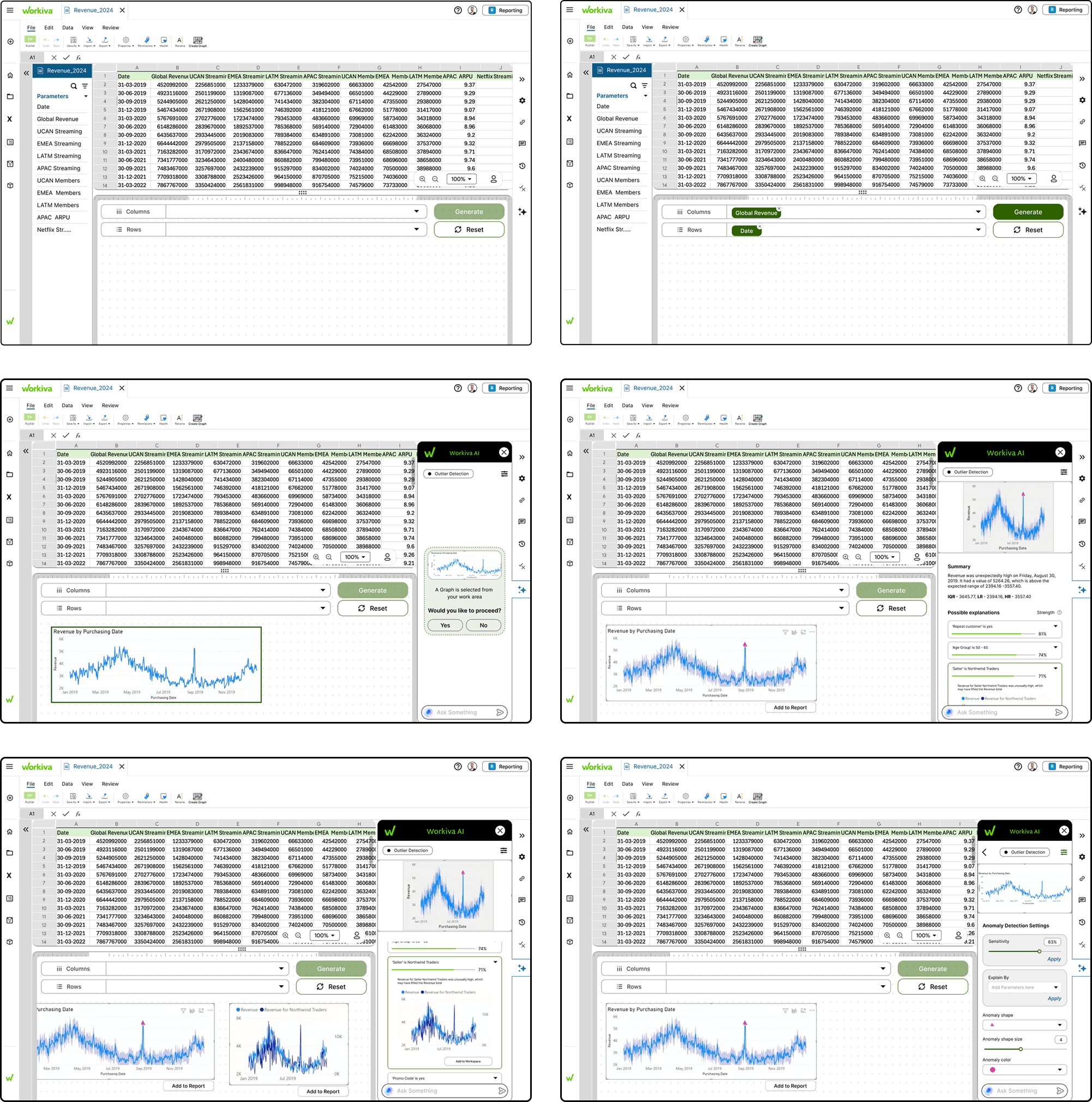
High-fidelity prototype of the integrated anomaly detection system
Impact & Results
The solution addresses critical workflow inefficiencies and positions Workiva as a leader in AI-powered financial data analysis.
Key Learnings
- AI integration must prioritize explainability over pure accuracy for enterprise adoption
- Real-time feedback loops are crucial for maintaining user trust in automated systems
- Visual hierarchy and progressive disclosure help users navigate complex data insights